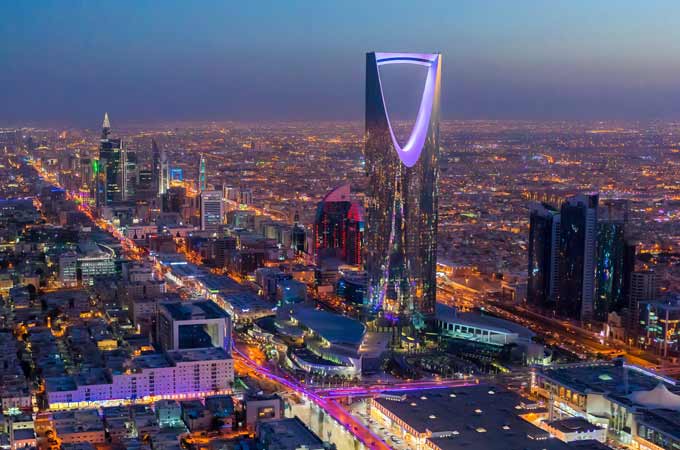
Saudi Arabia is expecting a strong economic recovery in 2027, with real GDP projected to grow by 10.9%, following an estimated contraction of 2.1% this year, as a rebound in oil activities is expected to provide fresh impetus to the economy.
The growth forecast, outlined in the Ministry of Finance's 2027 budget projections and highlighted in an overview by Al Rajhi Capital, represents a significant turnaround in economic performance.
The Kingdom is also anticipating an improvement in its fiscal position, with higher revenues and lower expenditure expected to reduce the budget deficit.
The Ministry of Finance expects the deficit to narrow by 22% to SAR191 billion ($50.9 billion) in 2027, equivalent to 3.6% of GDP, compared with an estimated SAR245bn, or 4.9% of GDP, in 2026.
The International Monetary Fund (IMF), meanwhile, projects Saudi Arabia's economy to grow by 7.9% in 2027, below the Ministry of Finance's forecast of 10.9%.
The strong growth outlook comes as the Kingdom continues to pursue its economic diversification programme, with investments in infrastructure, tourism, housing, technology and other strategic sectors intended to broaden the sources of economic activity.
Improving fiscal position
Saudi Arabia's total revenues are projected to increase by 0.9% year-on-year to SAR1.202 trillion in 2027, compared with an estimated SAR1.191 trillion this year. Expenditure, meanwhile, is expected to decline by 3.1% to SAR1.392 trillion from SAR1.436 trillion.
The improvement in revenues is expected to be supported by stronger private consumption and improved tax collection. Tax revenues are forecast to reach SAR414bn, up from an estimated SAR397bn in 2026.
Taxes on goods and services are expected to account for SAR322bn of the total, compared with SAR302bn this year, reflecting the anticipated strength of domestic economic activity.
Other revenues, which include oil-related income, are projected at SAR787bn, slightly below the estimated SAR794bn in 2026.
Despite the moderation in overall expenditure, the government plans to maintain substantial investment in development projects. Capital expenditure is budgeted at SAR178bn in 2027, equivalent to 12.8% of total spending, compared with an estimated SAR182bn this year.
The government's medium-term projections indicate that revenues will rise further to SAR1.302 trillion in 2028 and SAR1.351 trillion in 2029. Expenditure is forecast to reach SAR1.479 trillion and SAR1.544 trillion, respectively.
Development priorities
Healthcare, education and infrastructure remain among the government's major spending priorities, although their allocations are lower than the estimated levels for 2026.
The health and social development sector has been allocated SAR256bn for 2027, compared with SAR304bn in the 2026 estimate, a decline of 16%. Education spending is projected at SAR195bn, down 5% from SAR205bn.
Infrastructure and transportation receive SAR38bn, compared with SAR41bn in 2026, while municipal services spending is set to increase by 12% to SAR93bn.
The budget also outlines a number of development targets for next year, including the delivery of 80,000 housing units and developed land to expand housing options for Saudi families.
Tourism remains a key pillar of diversification, with the Kingdom targeting 144.5 million tourists and SAR358.4bn in tourism spending in 2027.
In transport, the first phase of Riyadh Metro Line 7 is among the targets, while partnership contracts are planned for Taif and Qassim airports and two road projects to expand private sector participation and improve connectivity.
The technology sector is also receiving attention, with a target to qualify 15,000 specialists in data and artificial intelligence to meet labour market requirements.
Send us your company’s news today and they could be featured on ABC’s Community News tommorow.