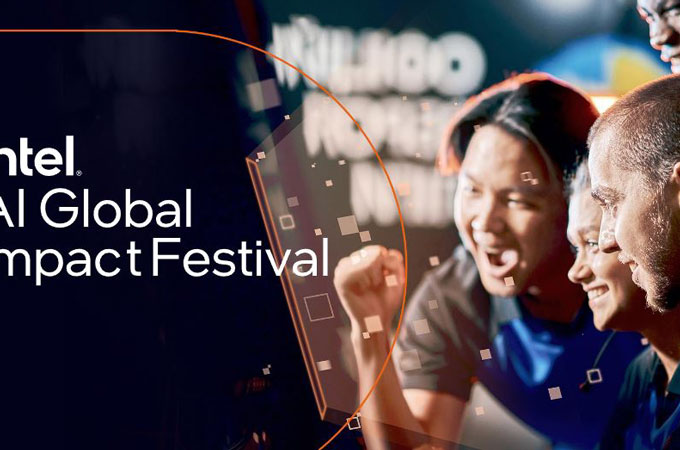
Intel has announced the 2026 winners of the Intel AI Global Impact Festival, recognising students and young developers from the UAE, Saudi Arabia and around the world who are using artificial intelligence to address some of society’s most pressing challenges.
For the 13- to 17-year-old age group, the UAE is home to one of the global award-winning projects:
Qatrah: Intelligent AI Water-Saving System | UAE
Created by Meera Omar Eissa Ali Almahri and Dana Ibrahim Ahmad Abdallah Ali from Applied Technology Schools, Qatrah is an intelligent AI water-saving system focused on supporting water conservation.
For the 18-year-old+ age group, the country winners are:
EyeSpeak: AI Vision Assistant for Seniors | UAE
Created by Sushma Geddam, Himanshi Mehtani and Diya Murjani from Wollongong University in Dubai, EyeSpeak is an AI vision assistant designed to support seniors.
Sarab: Smart Energy Management for Greener Buildings | Saudi Arabia
Created by Abrar Alnwybt, Maisara Elmarakby and Leen Ghazal from Prince Sattam bin Abdulaziz University, Sarab is a smart energy management solution focused on supporting greener buildings.
Across the festival, this year’s winning projects demonstrate what can happen when students have access to AI skills, technologies and opportunities to turn their ideas into impact. Their innovations tackle challenges ranging from helping people with disabilities communicate more independently and detecting wildfires earlier, to advancing sustainable agriculture and making language learning more accessible.
“AI has the potential to help solve some of the world’s most complex challenges, but realising that potential starts with giving people the skills and opportunities to use it. This year’s AI Global Impact Festival winners demonstrate what’s possible when young innovators combine technical skills with creativity and purpose. Their ideas are an inspiring example of how the next generation can help shape a future where AI delivers meaningful impact for everyone,” said Robin Colwell Bolton, Senior Vice President, Global Government Affairs.
Global Award-Winning Projects
For the 18-year-old+ age group, the global award-winning projects are:
FluentifyAI: English fluency for Japanese learners | Japan
Created by Shaunak Jadhav, Atharv Kulkarni and Zayaan Nanji, FluentifyAI is a local, AI-powered pronunciation coach designed to help Japanese learners of English build speaking confidence. The solution analyses pronunciation offline and delivers personalised bilingual feedback and practice exercises while keeping voice data private.
PlagueBot VR: Edge AI and robotics for precision agriculture | Mexico
Created by Eliot Calderón Romero, Daniel Orlando Camacho Campos and Adan Lopez Lozano, PlagueBot VR is an autonomous greenhouse robot designed to improve pest management and reduce hazardous pesticide exposure in tomato farming. Combining an Intel RealSense depth camera, edge AI vision optimised with OpenVINO and a virtual-reality digital twin, the system enables real-time pest and crop-ripeness detection with remote agronomist oversight.
MycoGuard: Autonomous physical AI for circular mushroom farming | Singapore
Created by Justin Dermawan, Seth Yong and Kiong Rui-En Rei, MycoGuard applies physical AI to circular agriculture. Powered by an Intel Core Ultra AI PC, smart sensors, a multimodal large language model and a robotic arm running on OpenVINO, the system cultivates mushrooms using repurposed cardboard waste, detects contamination and automates harvesting.
From AI skills to real-world impact
Beyond the six global award winners, students across countries and territories were recognised for projects addressing challenges in healthcare, environmental sustainability, accessibility, education, infrastructure and public safety.
Their work ranges from ScamTriage, a privacy-first AI solution from Canada designed to identify digital scams before users act, to SmogSense from Kenya, an affordable edge-AI air-quality monitoring device. Other winning projects include Green Vision AI from India, which uses AI to help cities plan for declining green spaces, and Project Lifeline from Vietnam, an air-gapped AI emergency dispatcher designed to support operators during mass emergencies.
Across the 18-year-old+ age group, country and territory winners explored applications including smartphone navigation for people who are blind, AI-assisted education, predictive road maintenance, fire safety, smarter building energy management, agricultural intelligence and elderly care.
Together, these projects illustrate a larger shift in AI education: moving beyond learning how AI works to understanding how it can be responsibly applied to meaningful problems.
Building the next generation of AI innovators
This year’s winners demonstrate the breadth of that potential. Whether helping someone communicate more independently, protecting communities from wildfires, reducing agricultural waste or making education more accessible, these young innovators are showing how AI can become a practical tool for solving human challenges. Their projects offer a glimpse of what’s possible when the next generation has the skills and technology to turn ideas into action.
Intel’s Digital Readiness Programmes are helping expand access to technology and AI skills worldwide. To date, the programmes have reached more than 10 million people through collaborations with 30 national governments and 29,000 institutions, advancing Intel’s commitment to more accessible, responsible and inclusive AI.—TradeArabia News Service
Send us your company’s news today and they could be featured on ABC’s Community News tommorow.