Iran and China have pushed back against US President Donald Trump’s threat to impose what Washington says will be the “toughest sanctions in history” on Tehran, warning that unilateral economic pressure could further destabilise the region and damage global trade.
Iran’s Foreign Ministry on Saturday condemned the planned US sanctions as an attempt to impose American authority beyond its borders, while China, one of Iran’s most important trading partners and the main buyer of its oil, said sanctions were not in the interests of any party and urged diplomacy.
Foreign Ministry spokesman Esmaeil Baghaei said the impending US measures amounted to an “assertion of extraterritorial sovereignty over every independent member state of the United Nations.”
“Such secondary sanctions find no foundation in international law,” Baghaei said in a post on X.
Tehran had already warned on Friday that any new US threats would draw a “devastating” response. The Iranian Foreign Ministry described Trump’s economic pressure as “a recipe for an abysmal return to full-scale classic colonialism.”
The warnings came ahead of a scheduled announcement on Monday by US Treasury Secretary Scott Bessent, who is expected to unveil new economic measures against Iran while pressing China to cooperate with Washington.
China has a particularly important role in the sanctions standoff. According to 2025 data from analytics firm Kpler, Chinese buyers account for more than 80% of Iran’s seaborne oil exports.
Beijing has nevertheless resisted Washington’s pressure campaign, arguing that sanctions are not a solution to the confrontation.
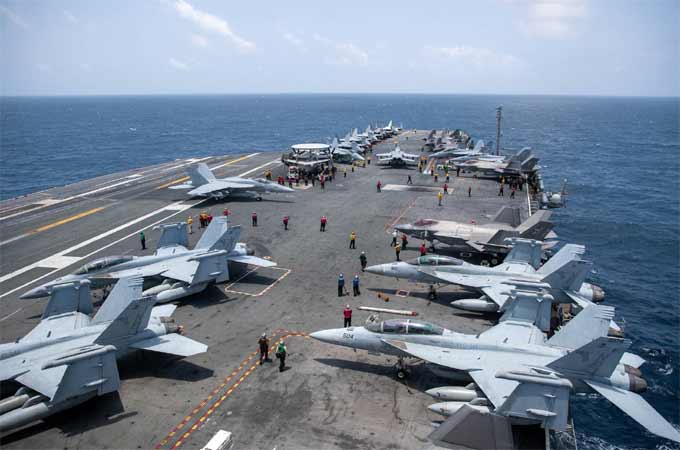
The exchange of threats comes as the war between the US and Iran approaches its sixth month. Although the two sides were not exchanging fire at the time of the latest statements, neither were they engaged in peace negotiations.
The Strait of Hormuz remains at the centre of the confrontation. There were signs of a limited increase in shipping activity over the past week. A CNN analysis of UK Maritime Trade Operations data showed that 103 vessels entered the strait and 89 left, a 27% increase from the previous week. However, traffic remains only about 20% of the seven-day pre-war average.
More than 80% of liquid cargoes moving through the area over the past two weeks have reportedly used the Omani route, a UN-authorised shipping channel opposed by Tehran.
The US Navy has also increased its role in facilitating energy shipments. US Energy Secretary Chris Wright said on Saturday that the Navy had helped move more than 15 million barrels of oil and petroleum products out of the strait, with another five million barrels transported through pipelines.
The confrontation is already feeding into energy markets. Brent crude settled at $94.39 a barrel on Friday, up 61 cents, or 0.65%, while US West Texas Intermediate gained 23 cents, or 0.26%, to settle at $87.06.
The pressure is also being felt by US consumers, with the national average gasoline price reaching $4.11 a gallon on Friday, nearly $1 higher than a year earlier.
Trump, speaking at a campaign rally in South Carolina on Friday, described the war with Iran as “a little detour” and said gasoline prices would soon fall, while questioning whether further military action was necessary.
Send us your company’s news today and they could be featured on ABC’s Community News tommorow.