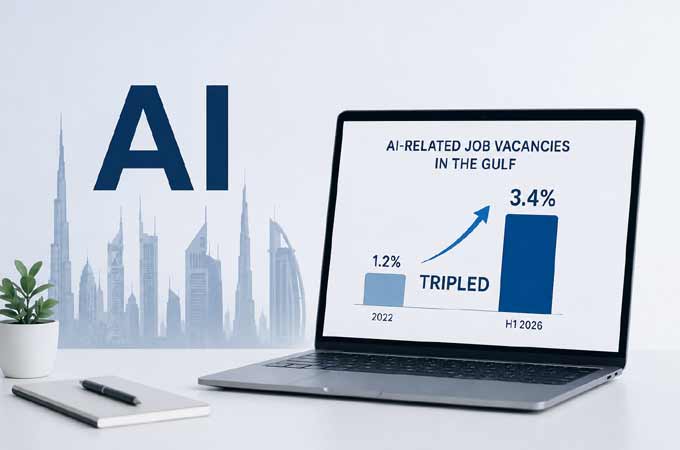
The share of professional job vacancies in the Gulf requiring artificial intelligence (AI) skills has nearly tripled over the past four years, but for much of the region's economy the technology has yet to make a meaningful impact on hiring, according to data from Middle East recruitment platform GulfTalent.
AI-related duties, skills or tools were mentioned in 3.4% of professional vacancies advertised during the first half of 2026—about one in every 30 jobs—up from 1.2% in 2022, based on an analysis of vacancies posted on GulfTalent across the UAE, Saudi Arabia and Qatar.
The increase follows the launch of ChatGPT in late 2022, which accelerated the adoption of generative AI across businesses. The pace of AI-related hiring has gathered momentum over the past two years as platforms such as Claude, Gemini and Copilot have become widely used workplace productivity tools.
Despite the rapid growth, AI-related hiring remains heavily concentrated in a handful of industries. The technology sector leads by a wide margin, with nearly one in three vacancies requiring AI-related skills or responsibilities. The banking and audit sectors follow, with around one in 15 job openings referencing AI.
Outside these sectors, AI adoption in recruitment remains limited. Oil and gas and real estate each reference AI in only about one in 30 vacancies, while industries including construction, retail, healthcare, manufacturing, education and hospitality report AI requirements in just one in 100 vacancies or fewer.
Early stages still
The findings suggest that although AI is gaining traction in selected knowledge-intensive industries, its influence on recruitment across the broader Gulf economy remains at an early stage.
Beyond these sectors, involvement drops even further. Oil and gas and real estate reference AI in roughly one in 30 vacancies, while a long list of sectors, including construction, retail, healthcare, manufacturing, education and hospitality, sit at one in a 100 or fewer. For much of the Gulf economy, AI has yet to make a meaningful mark on hiring.
AI involvement also rises with seniority. In non-supervisory roles, around one in 30 vacancies involves AI. That climbs to roughly one in 12 in senior leadership vacancies, as organisations increasingly look to executives to set direction on AI strategy and adoption.
Types of AI roles
A closer look at AI vacancies shows that the roles span using AI as well as delivering AI to others. Based on an analysis of AI-connected vacancies advertised on GulfTalent in the first half of 2026, about a third require use of AI as part of the job. Another third involve implementing and rolling out AI solutions. A quarter are sales jobs involving selling AI products and services. Fewer than one in ten involve building and training AI models directly.
Demand is also not limited to engineers and data scientists. AI now appears in the job descriptions of sales executives, marketers, product managers and consultants, underlining how the technology is spreading beyond specialist technical teams into the wider workforce.
International comparison
GulfTalent’s finding of AI involvement in 3.4 percent of vacancies is broadly consistent with other reputable studies, including PwC’s Global AI Jobs Barometer, which found that 3.2 percent of UAE vacancies in 2025 required AI skills.
These figures place the Gulf at the higher end of global AI adoption, ahead of the US (2.5%) and UK (1.9%), though behind countries such as Singapore (4.8%), based on comparable data from Stanford’s AI Index.
Outlook
Despite the rapid growth, the findings suggest that the Gulf is still at an early stage of its AI transition. AI remains a minority of vacancies, is concentrated in a few sectors, and is only beginning to reach the breadth of roles and industries where its impact could be greatest.
According to GulfTalent, the trend points to a widening set of opportunities for professionals able to apply AI within their field, rather than only those who build it. For employers, GulfTalent notes that AI capability is becoming a competitive necessity in sectors such as technology, while most other sectors have yet to begin their AI journey.
Research methodology
GulfTalent’s analysis was based on 118,000 direct employer vacancies advertised in the UAE, Saudi Arabia and Qatar between January 2022 and June 2026, with AI involvement measured by the share of vacancies referencing AI-related duties, skills or tools. The breakdown of role types is based on a detailed classification of 420 AI-connected vacancies posted in the first half of 2026.
Send us your company’s news today and they could be featured on ABC’s Community News tommorow.