The Emirates Group released its 2025–26 Annual Report, achieving new record profit, revenue, and cash balance levels despite a disruptive and challenging final month of its financial year.
The Dubai-based group reported record profits, revenues, and
cash reserves across both Emirates airline and dnata.
For the year ending March 31, 2026, the Emirates Group posted
a record profit before tax of AED24.4 billion ($6.6 billion), a 7% increase
from the previous year, with a strong profit margin of 16.2%.
Group revenue rose 3% to an all-time high of AED150.5 billion ($41 billion), while cash assets climbed 12% to AED59.6 billion ($16.2 billion). EBITDA reached AED 41.1 billion ($11.2 billion), underlining the group’s strong operational performance.
Following the implementation of OECD Pillar Two tax rules in the UAE, the group’s corporate tax rate increased from 9% to 15%. After taxes, net profit stood at AED21 billion ($5.7 billion), up 3% year-on-year.
The group also declared a dividend of AED3.5
billion ($1 billion) to its owner, the Investment Corporation of Dubai.
During the year, Emirates Group invested AED17.9 billion ($4.9
billion) in aircraft, facilities, technologies, and infrastructure to support
future growth.
Its global workforce expanded 8% to 130,919 employees, while
the number of UAE nationals employed by the group surpassed 4,000.
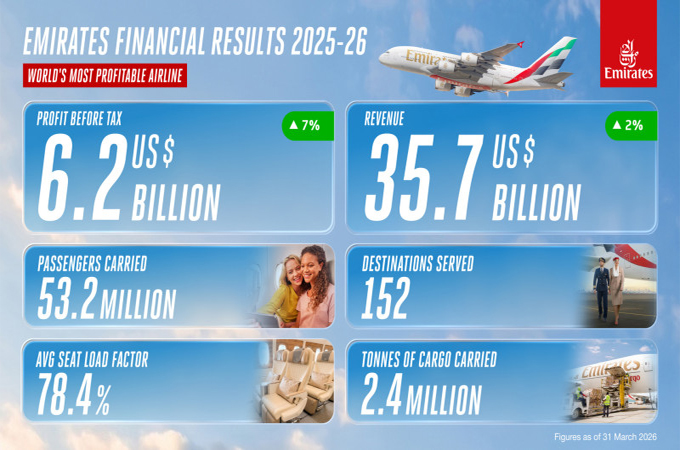
Emirates airline retained its position as the world’s most
profitable airline, reporting a record pre-tax profit of AED 22.8 billion ($6.2
billion), also up 7% from last year, with a profit margin of 17.4%.
Revenue increased 2% to AED 130.9 billion ($35.7 billion),
and cash assets reached a record AED 54.9 billion ($15 billion).
The airline expanded its global network during the year by
launching services to four new destinations: Da Nang, Hangzhou, Siem Reap, and
Shenzhen.
By March 2026, Emirates served 152 cities across 80
countries and strengthened its connectivity through 32 codeshare and 117
interline partnerships, giving customers access to more than 1,700 cities
worldwide.
Fleet expansion remained a major focus. Emirates received 15
Airbus A350 aircraft, bringing the total number of A350s in operation to 19
flying to 21 destinations.
The airline ended the year with a fleet of 277 aircraft and
an average fleet age of 10.8 years. At the 2025 Dubai Airshow, Emirates
announced additional fleet investments worth $41.4 billion, including orders
for 65 Boeing 777-9s and eight A350-900s.
Its total order book now stands at 367 aircraft scheduled
for delivery through 2038.
Passenger and cargo capacity increased slightly to 60.6
billion available tonne kilometres (ATKMs).
Emirates carried 53.2
million passengers during the year, while maintaining a strong seat factor of
78.4%. Passenger yield rose 4%, reflecting sustained demand and pricing
strength.
Operating cash flow reached AED 32 billion ($8.7 billion),
allowing the airline to fund growth and meet all financial obligations.
Fuel remained the airline’s largest operating cost,
accounting for 29% of expenses, although total fuel expenditure fell slightly
due to lower fuel prices.
Emirates continued investing heavily in customer experience.
The airline accelerated its $5 billion fleet retrofit
programme, with 91 aircraft refurbished by year-end to feature upgraded cabins
and Premium Economy seating.
Emirates also partnered with Starlink to introduce
high-speed onboard Wi-Fi, already installed on 21 aircraft.
On the ground, the airline launched new premium customer
services, including Emirates First check-in facilities in Dubai,
chauffeur-drive expansions in Japan, and enhanced accessibility services for
travellers with disabilities and autism.
It also invested in staff development through new training
centres and a future Cabin Crew Village in Dubai designed to accommodate 12,000
crew members.
Emirates Skywards celebrated its 25th anniversary with
expanded rewards and loyalty benefits, including Premium Economy redemptions
and partnerships with flydubai.
Emirates SkyCargo also delivered strong results,
transporting 2.4 million tonnes of cargo, a 3% increase year-on-year.
Revenue reached AED 16.2 billion ($4.4 billion),
contributing 12% of Emirates’ total revenue.
During the year, SkyCargo expanded its freighter network and
introduced new logistics products, including Emirates Courier Express and
specialist aerospace cargo solutions.
The cargo fleet ended the year with 13 Boeing 777 freighters
and eight more on order.
To support fleet growth, Emirates raised AED 10 billion
through multiple financing structures and continued implementing fuel and
currency hedging strategies to manage market volatility.
Among the Group’s subsidiaries, Emirates Flight Catering
recorded 12% revenue growth from external customers, serving over 16 million
meals during the year.
MMI and Emirates Leisure Retail generated AED 2.9 billion in
revenue despite challenging market conditions and expanded their retail and
food-and-beverage footprint internationally.
dnata, the Group’s global air and travel services provider,
also achieved record performance.
Profit before tax increased 2% to AED 1.6 billion ($437
million), while revenue rose 12% to AED 23.6 billion ($6.4 billion).
International operations now account for 77% of dnata’s revenue.
dnata invested AED 858 million ($234 million) in new
catering facilities, cargo infrastructure, and electric ground support
equipment.
It also acquired logistics and travel-related businesses to
strengthen operations in Australia, New Zealand, and digital travel
distribution.
Airport operations remained dnata’s largest business
segment, generating AED 11.2 billion in revenue.
The company handled nearly 889,000 aircraft turns globally
and processed 3.2 million tonnes of cargo.
Significant projects included a new automated cargo facility
in Amsterdam and expanded operations in Italy, Manchester, and Azerbaijan.
dnata’s catering and retail division generated AED 8.1
billion in revenue, serving 115.3 million inflight meals and securing major
airline contracts.
Its travel services business also performed strongly, with
revenue growing 5% to AED 4.1 billion and total travel transaction value
reaching AED 10.1 billion.
Sustainability remained a strategic priority across the
Emirates Group. Initiatives included sustainable aviation fuel partnerships,
investments in more fuel-efficient operations, waste reduction programmes,
electric ground vehicles, and conservation projects in Australia.
The Group also expanded social and charitable programmes
globally, supporting disadvantaged children, sports access initiatives, medical
missions, food donations, and community development projects.
Sheikh Ahmed bin Saeed Al Maktoum, Chairman and Chief
Executive, Emirates airline and Group said: “These outstanding results,
despite significant challenges in the last month of our financial year,
reaffirm the strength and resilience of the Emirates Group’s business model,
which is rooted in safety, excellence, innovation, people and partnerships.
“For the first 11 months of 2025-26, the picture across the
Group was very positive. Strong demand for our products and services was
driving revenue, and we were achieving healthy margins thanks to our sustained
investments in product, people, technology and brand. Month after month, we
were surpassing our targets.
“On 28 February, military activity massively disrupted
global commercial air traffic in the Gulf region, including in the UAE.
Emirates and dnata quickly mobilised to support our people and affected
customers, protect our assets, and ensure business continuity.
“We are fortunate to be based in Dubai, where years of infrastructure investments and a cohesive aviation ecosystem has enabled the government to quickly secure safe corridors for commercial flights. Emirates and dnata have since gradually restored operations at DXB. Although we are still operating at a lower passenger capacity than pre-disruption, cargo operations have ramped up to support the movement of essential goods into and through the UAE.” -TradeArabia News Service
Send us your company’s news today and they could be featured on ABC’s Community News tommorow.