The US has positioned forces in the Gulf region, pressuring Iran to accept a set of US demands. Diplomatic channels remain open, but miscalculation by either party could result in an escalation. CIO Office Viewpoint from Lombard Odier by Dr Nannette Hechler-Fayd’herbe, Head of Investment Strategy, Sustainability and Research, CIO EMEA, examines the potential implications if US-Iran tensions were to escalate.
President Trump has called on Iran to negotiate limits to its nuclear enrichment programme, dispose of enriched uranium stockpiles, restrict ballistic missile numbers and their range, as well as limit support for its allies.
Reports of progress through indirect negotiations in Oman on nuclear questions are encouraging. Trump has said negotiations may last as long as a month and recently added that an agreement covering only nuclear issues may be acceptable.
Incentives to reach a negotiated solution
The stakes of any escalation would be high for both countries. Iran is already significantly weakened economically and appears to be fragile domestically after repressing demonstrations. President Trump has promised not to drag the US into another ‘forever war,’ and that position is likely to take on particular relevance ahead of November’s mid-term elections.
Any intervention in Iran looks much more complicated than the recent US strike in Venezuela. Unlike the US’s early-January action in Venezuela, there has been no sign of Iranian government or military defections that could facilitate a change of leadership.
CIO Office Viewpoint from Lombard Odier says its base case, therefore, remains a negotiated outcome. “This scenario is also in line with financial markets’ calmness so far. The VIX, an index of US equity market volatility, remains just below its long-term average levels, and there is no sign that risk premia – the excess returns demanded by investors for holding a riskier asset – are adjusting in anticipation of an escalation.
“Overall, we keep our moderate pro-risk investment strategy in place. This tactical positioning is backed by a stronger-than-expected macroeconomic outlook and solid corporate earnings trends. It includes a preference for emerging over developed market equities, an overweight allocation to emerging market hard currency bonds, and an underweight to developed market government bonds. We also maintain our overweight position in gold for diversification and risk-hedging purposes.”
Assessing risk scenarios
Nevertheless, a build-up of the US military in the region means that a US strike remains a possibility. Iran has said it would respond to any attack, with options including strikes on US bases in the region, and disruption to shipping or closure of the Strait of Hormuz, breaking with its previous pattern of restraint or backing down. We therefore consider two risk scenarios. The first would be US strikes but with no lasting disruption, and the second would be US strikes and a major Iranian response, including prolonged disruption to the Strait of Hormuz.
While the impact of geopolitical tensions on financial markets is often limited or transitory, in this case oil markets create a direct link to the global economy, and broader supply chains, says the report.
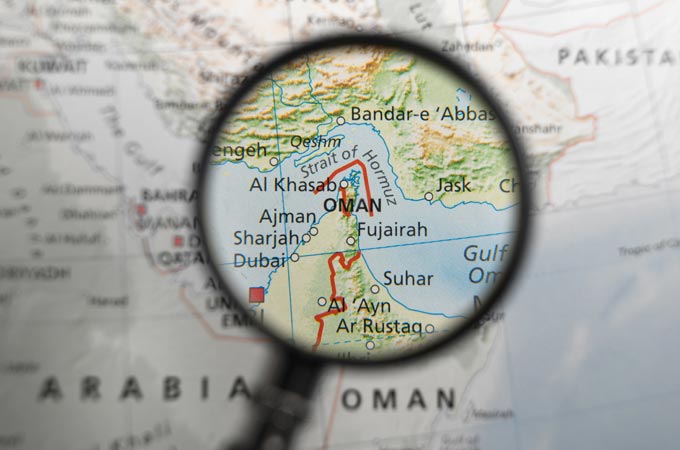
Around one-third of the world’s seaborne crude oil flows through the Strait of Hormuz, which is also key for transporting liquefied natural gas (LNG), fertilisers, copper and aluminium. The Strait narrows to a shipping channel only 54 kilometres (34 miles) wide between the Iranian coast and Oman’s Musandam Peninsula, and there are few alternatives to re-route supplies. If the Strait were closed, a temporary spike in oil prices to $100 per barrel - or beyond - is plausible; global LNG prices would also be affected.
Any Iranian action in the Strait would be a high-risk, high-cost option for Iran itself because it would shut down its own oil exports, removing the regime’s primary source of income, and negatively affecting economies in Asia and the Middle East.
Tail risks and market implications
For now, contained oil prices are still giving a positive, and disinflationary signal for the global economy. While US-Iran tensions have pushed Brent crude oil prices to a four-month high, with one barrel now worth around $69, the recent rise in crude oil prices follows a period of sustained supply, and price weakness. Prices have declined from a $122/barrel high in mid-2022 to a range of $60-65/barrel in the last quarter of 2025. A global oil surplus and spare capacity among the Organization of the Petroleum Exporting Countries and other key oil producers (OPEC+) have contained prices, despite global tensions with crude-producing states from Iran, to Venezuela, and Russia.
Iran accounts for around 4% of global crude supplies, most of which is destined for Asian markets. Although sanctions have significantly weakened Iran’s oil output, OPEC estimated production at around 3.5 million barrels per day in 2025, with China as its largest customer.
The CIO Office Viewpoint estimates that a sustained 20%-to-30% increase in crude oil prices would depress global growth by between 0.5% and 1.0%. That would raise global headline consumer price inflation by a similar margin. Although the 1970s oil embargo triggered a deep recession, the global economy is now far less oil-dependent, and the US has shifted from being a major oil importer to the world’s largest producer.
Market reactions from a risk scenario would include a rise in commodity prices including gold, and more volatile equity markets, as the energy sector adjusts.
“We would also expect strong demand for haven assets, and government bond yield curves to steepen as inflation expectations rise and central banks assess the prospect of slower economic growth. In such an event, the Swiss franc and Japanese yen, both traditional haven currencies, would appreciate, although any strengthening in the Swiss franc may be tempered by Swiss National Bank intervention. The longer-term market reactions would depend on the length and the severity of a crisis.” - TradeArabia News Service
Send us your company’s news today and they could be featured on ABC’s Community News tommorow.